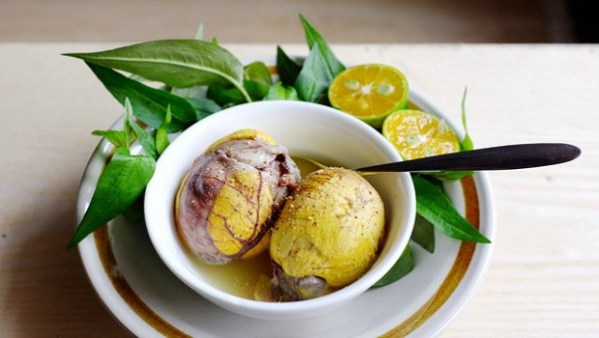
A balut is a fertilised bird egg (usually a duck) which is incubated for a period of 14 to 21 days depending on the local culture and then boiled or steamed. The contents are eaten directly from the shell. Balut that are incubated for longer periods have well-developed embryo and the features of the duckling are recognizable. The partially-developed embryo bones are soft enough to chew and swallow as a whole. The mallard duck (Anas platyrhynchus), also known as the “Pateros duck”, is considered to be the most important breed for egg production to make balut.
Balut is a common street food in the Philippines and other localities, and is also sold in stores and malls. It is a relatively cheap source of protein and calcium. Balut was introduced to the Philippines by the Chinese around 1885 and since then, balut has been included as a traditional part of the culture. Wherever Filipinos migrated for work, a large market for balut would develop. Controversies arose as knowledge of the food spread around the South East Asian countries and then globally. People questioned the ethics of eating balut.[
Balut spelled standardized as balot) is a developing bird embryo (usually a duck) that is boiled and eaten from the shell. It originated from and is commonly sold as street food in the Philippines. Often served with beer, balut is popular in Southeast Asian countries, such as Laos (khai look; Lao: ໄຂ່ລູກ), Cambodia (pong tia koun; Khmer: ពងទាកូន),[2] Thailand (Khai Khao; Thai: ไข่ข้าว) and Vietnam (Vietnamese: trứng vịt lộn or hột vịt lộn).
The Tagalog and Malay word balot means “wrapped”. The length of incubation before the egg is cooked is a matter of local preference, but generally ranges between 14 and 21 days.
Here in the Philippines Balut is just only 18 PESOS you may enjoy your night , because every other Pilipino use this for there occupation.
(CTTO)
 Pinoy StreetFoods